
Reduce Coal Emissions? “No” Say NGOs, “Yes” Say Voters
It’s too soon to be alarmed, but there may be an outbreak of common sense upon us. Unless stopped by doctrinaire ideologues, recent signs of rare agreement on the energy front just might lead to actual progress.
We refer first to the bipartisan support for “45Q” fossil energy technology tax credits. Then last week’s Senate hearing on the “Use It Act” again showed Rs and Ds can leave their knives at the door for a calm and even constructive discussion on practical solutions. And this week, West Virginia Democrat Sen. Joe Manchin introduced the “Energy Reliability Act” while his Republican colleague Sen. Shelley Moore Capito introduced a similar measure offering tax credits to safeguard grid reliability. Both bills are based on an overlooked conviction that is nevertheless widely shared by those who are chiefly concerned with carbon emissions as well as by those like Manchin and Capito who’re concerned about baseload reliability: all agree the market is imperfect.
The wonder here is why, in the energy discussion as in so many others, there hasn’t been more cooperation? Why so little agreement prevails in the capital when out in “the provinces” most voters typically reject extreme views in favor of common sense? One reason is because here conventional wisdom – developed and defended by like-minded people — often goes unchallenged. Take the example of so-called clean coal technology: it’s been branded as farcical by NGOs who view any dime spent to develop low emission coal combustion as a lost opportunity to hasten the coming of a carbonless future.
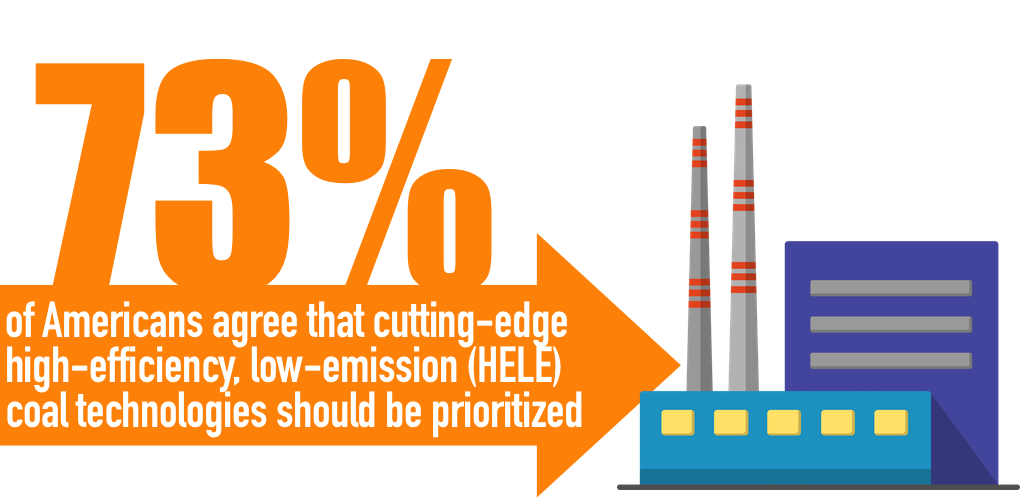
But a new poll commissioned by NMA shows a solid majority (73%) of Americans agree that we should upgrade existing coal-based power plants with the high-efficiency, low-emission (HELE) technologies being built in China and elsewhere in the world. Perhaps surprisingly, the poll by Morning Consult also showed that most Americans (55%) favor upgrading both nuclear and coal fleets to preserve fuel diversity.
For any member of Congress facing testy, divided voters, going against conventional wisdom may not be welcomed back home. But not all Beltway certitudes are received with slack-jawed acceptance by gullible voters. The Morning Consult findings suggest there is room for a position that says we can strengthen the nation’s energy portfolio without abetting environmental Armageddon.
It’s an argument that plays directly into what Americans do believe, e.g. resourcefulness, technological innovation and leading instead of following. That’s why the shale revolution boomed here rather than in France and why “energy dominance” plays better in Peoria than “energy conservation.”
Voters become cross when they learn that China is home to 90 state-of-the-art “ultra-supercritical” coal plants and we have only one. If China can find the resources to build plants with far greater thermal efficiencies that lead to significant reductions in emissions, why can’t the U.S. with the world’s largest coal supply?
Rapidly emerging countries in Asia may also wonder why we aren’t technology leaders. At its ministerial meeting last September, the Association of Southeast Asian Nations acknowledged the “need for increased promotion of clean coal technologies.” The UN reminds us that one in five people in the world still lack access to electricity. The three billion people who today rely on charcoal, biomass and animal waste for cooking may also hope for more leadership from the richest and biggest source of affordable power.
Something for the World Bank to ponder when it meets here this week to mull project financing strategy. And something serious for the rest of us to talk about on Earth Day this Sunday.
- On April 18, 2018