
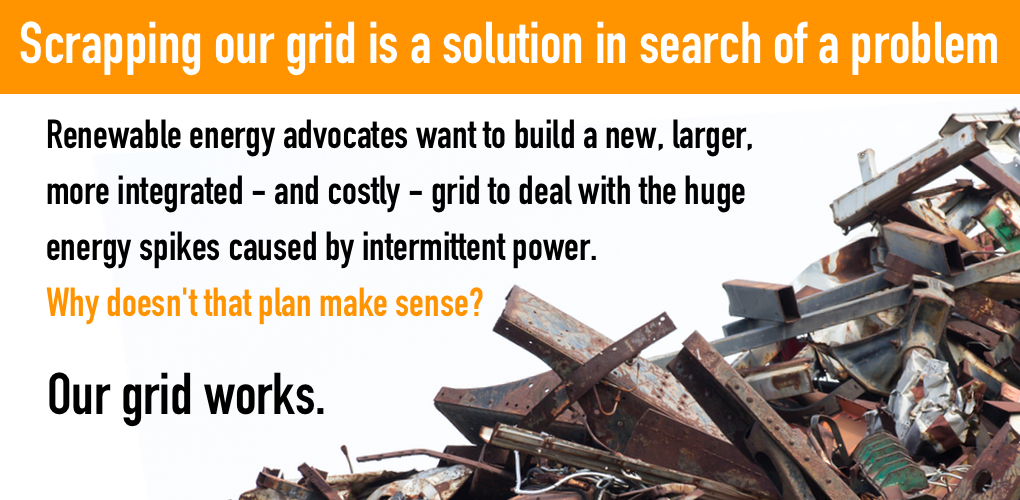
A Solution in Search of a Problem
It’s not uncommon to hear calls for rebuilding and transforming the electricity grid. In fact, renewable energy boosters say transforming the grid is an imperative if the nation is to reach their goal of 100 percent wind and solar power. But this call for transformation exposes some of the underlying problems with the proposed wind and solar mandate.
Wind and solar don’t easily fit within the electricity grid that we have – in fact, they add considerable stress to it. As more and more wind and solar generation are added to the grid, operators must accommodate huge spikes in power when they’re not needed and a complete loss of generation when it’s needed most. These are the hourly and day-to-day challenges of integrating intermittent sources of energy. The even larger challenge is accommodating dramatic seasonal changes in wind and solar output that can last for weeks or months.
As renewable energy advocates see it, the answer to smooth out these peaks and valleys is to largely scrap the grid we have and build a huge new transmission network that can move power from one tip of the country to the other. The basic idea is that as the grid gets bigger and more integrated, bad weather in one region of the country can be offset with good weather for generating power in another.
Building this uber grid might make sense to some on paper but there are a number of very good reasons why it hasn’t happened and why it would be so hard to do. Right at the top of the list is the inarguable fact that the existing grid works.
Proposing to transform the grid is a solution in search of a problem. The grid, built up over more than a century, is the Rodney Dangerfield of the energy world – it doesn’t get nearly the respect it deserves.
The National Academy of Engineering named the modern electricity transmission system one of the greatest inventions of the 20th century. It provides affordable and reliable power to more than 300 million Americans. The grid is not a problem in need of fixing; nor is static.
The grid is undergoing constant change with upgrades and additions happening all the time. It’s more efficient, nimbler and reliable than ever. But as power companies will happily report, building new transmission lines – especially those that cross multiple state lines – is no easy feat. These major transmission projects often require 10 or more years for development, approval and construction. As such, they are tremendously expensive, and the U.S. has never attempted building the types of super transmission lines renewable advocates say must be the backbone of their new grid. Fortunately, we need not be the guinea pig in this effort.
As part of its Energiewende, or energy transition, Germany is trying to build transmission superhighways to move renewable generation from the north of the country to the south. Peter Altmaier, Germany’s minister of the economy and energy has called the progress on the effort – or rather the lack of it – a “catastrophe.”
The companies building the north-south high-voltage lines recently announced that the effort is going to cost 50 percent more than originally budgeted. The cost of the power cable “autobahns” is now projected to run $59 billion and it’s likely the price tag will only go up. The expense of this buildout is being borne as a surcharge by ratepayers who are already paying the highest electricity prices in Europe. If the German energy transition is a case study, it’s most certainly a cautionary one.
Germany’s struggle to integrate wind and solar power and build a new grid should be a warning to American policymakers. Solutions that require rebuilding our grid are hardly solutions at all. We’ve got to pump the brakes on the aspirational and unrealistic and focus instead on the available and achievable. Our reliable, affordable and secure supply of power shouldn’t be taken for granted.
- On March 14, 2019