
Guidance to Get Going
It’s not every day when a notice from the Internal Revenue Service (IRS) is cause for excitement. Yesterday was one of those rare exceptions.
The IRS finally issued guidance on the 45Q carbon capture tax credits. It was guidance the energy industry has been anticipating for two years, ever since Congress passed bipartisan legislation creating the credits to incentivize carbon capture and storage (CCS) projects. Without this long-awaited guidance, more than a dozen CCS projects, totaling billions of dollars in investment, have hung in limbo. The National Mining Association was supportive of the legislation when it was passed and has encouraged the IRS to move as quickly as possible.
The guidance is so important because no one was quite sure how to claim the tax credit promised by the legislation. You read that right. Not to make light of a serious issue but the future of a critical technology has been put on ice by a lack of direction from IRS accountants. For those who think Washington is far more Veep than House of Cards, this vignette has been very on-brand.
The criticism may be unfair – the issues the IRS is working through are immensely complicated – but there’s relief from all sides that two years of waiting is finally over. While the guidance issued Wednesday doesn’t answer every question, it’s an important step in the right direction and could be enough to get some projects moving. Let’s hope so.
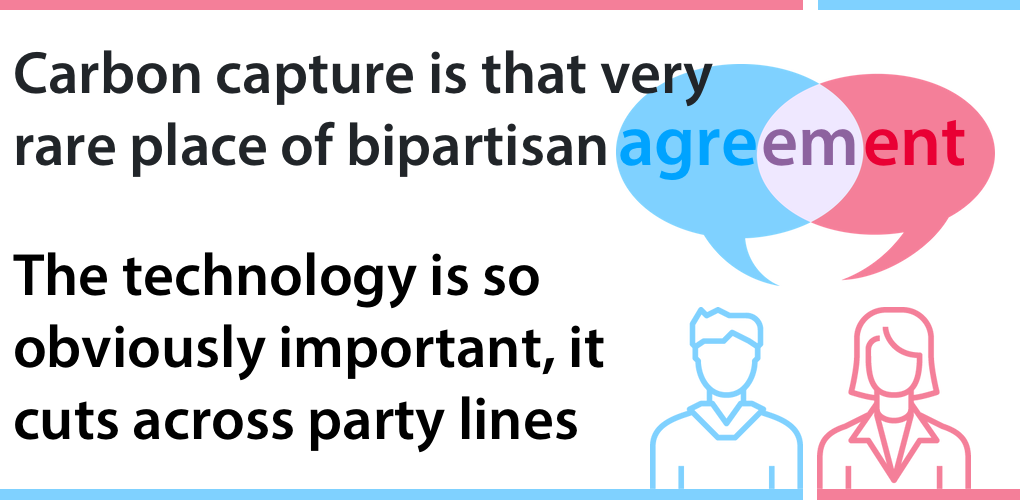
CCS is that very rare place of bipartisan agreement on energy and climate policy. Prominent Democrats have long been vocal supporters. And just a week ago it was given center billing in House Republicans’ innovation agenda, with new bills aiming to expand 45Q and to double down on support for CCS research and development. The technology is so obviously important, it cuts across party lines.
Frankly, the global math of energy use necessitates it. Fossil fuels meet 80 percent of the world’s energy needs. Coal is the world’s leading fuel for electricity generation and more than 75 percent of the world’s steel is produced with it. We can’t fuel switch our way to emissions-free, affordable and reliable energy. Natural gas needs CCS just as much as coal. Simply put, there’s no replicable, affordable approach to emissions reduction without CCS. It’s all the more reason we’ve got to get new projects up and running.
Yet, despite its necessity, CCS remains in its infancy and it’s anyone’s guess which branch of the CCS family of technologies is going to prove most effective or best suited to making a difference both in the U.S. and abroad. To find out, we’ve got to get more projects into the field and do some learning by doing.
According to the Global Carbon Capture and Storage Institute, there are currently 19 operating facilities worldwide that can capture, compress, transport and store CO2. While several dozen more facilities are in development, we are an order of magnitude off what’s needed. According to the Institute, 2,000 carbon capture facilities need to be up and running by 2040.
Fortunately, bipartisan support in Washington to greatly expand CCS development and deployment is matched by voter willingness to see the U.S. take just such a leadership role. In a recent poll, when asked whether the U.S. should assume global leadership in developing and deploying advanced coal and emissions-reduction technologies, 63 percent of respondents said yes; just 11 percent disagreed, with the remainder not offering an opinion. Those are remarkable numbers. It might be time to get the IRS a subscription to Turbo Tax.
- On February 20, 2020