
Coal’s Time Remains Now
The Economist has decided that it’s time for the world to stop using coal. The magazine argues that based on falling coal demand in Europe and the U.S., it’s not only possible for the world to turn its back on the leading fuel for electricity generation but it’s what responsible nations must do.
Perhaps it’s the season, but one can’t help but imagine a Dickens Scrooge-like character peering down a bespectacled nose typing furiously away to lecture Asia on its “dirty” habit. From its moral high ground in London – where Britain has just recently moved away from generating 40 percent of its power with coal and now boasts some of the most expensive electricity prices in the world – The Economist’s editors must be toasting to their achievement. But to what end?
The Economist has inadvertently made a rather strong case for why coal is here to stay and why a focus on emissions – not fuels – is a far more effective and replicable approach to global emissions reduction.
Consider the following passage: “In the past decade, as Europe has turned against coal, consumption in Asia has grown by a quarter. The continent now accounts for 77% of all coal use. China alone burns more than two-thirds of that, followed by India. Coal dominates in some medium-sized, fast-growing economies, including Indonesia and Vietnam.”
After firmly substantiating coal’s longevity, the piece continues, “it is no good waiting for Asia’s appetite for coal to fade. New plants are still being built. Many completed ones are not yet fully utilised and still have decades of life in them. Nor is it enough to expect a solution from ‘clean coal’ technologies.”
According to The Economist, carbon capture utilization and storage (CCUS) technologies are too expensive to make a difference. They may help with industrial uses, but they can’t be deployed at scale to reduce emissions from the power sector. Yet, just a few paragraphs earlier, the same writer declares that, “tax credits and subsidies have prompted renewables to scale up, which has in turn helped drive down their costs,” making them price-competitive the world over. The dots are there to be connected, if only The Economist could.
Global energy demand – particularly electricity demand – will soar as the global population reaches 10 billion by midcentury and per capita energy consumption continues to grow. As one development expert has noted, Californians will soon use more electricity for video gaming than the entire population of Ethiopia – 100 million people – uses for everything.
The data is rather clear: We remain firmly in an era of energy addition, not one of transition. Prioritizing technological innovation for the fuels and energy infrastructure the world leans on – and will continue to lean on – has to be a priority. Committing to R&D, providing incentives and lowering the barriers to deployment to allow learning by doing can bring down costs and produce scalable solutions for essential technologies of all kinds. There is no replicable approach to emissions reduction that doesn’t include a great leap forward with CCUS. It’s past time to make this most critical of technologies the international priority energy experts tell us it must be.
Chastising Asia – or any nation, anywhere – for prioritizing the affordable, reliable energy provided by coal, which continues to underpin industrialization and the herculean efforts to lift hundreds of millions out of crippling energy poverty, is not thought leadership. Rather, it’s tired posturing that sloppily dismisses just how essential reliable and affordable electricity is to the world and how obviously costly and difficult a pivot to a renewable-only future will be. California and Germany’s struggles – the ongoing and mounting reliability and affordability issues – have made that abundantly clear.
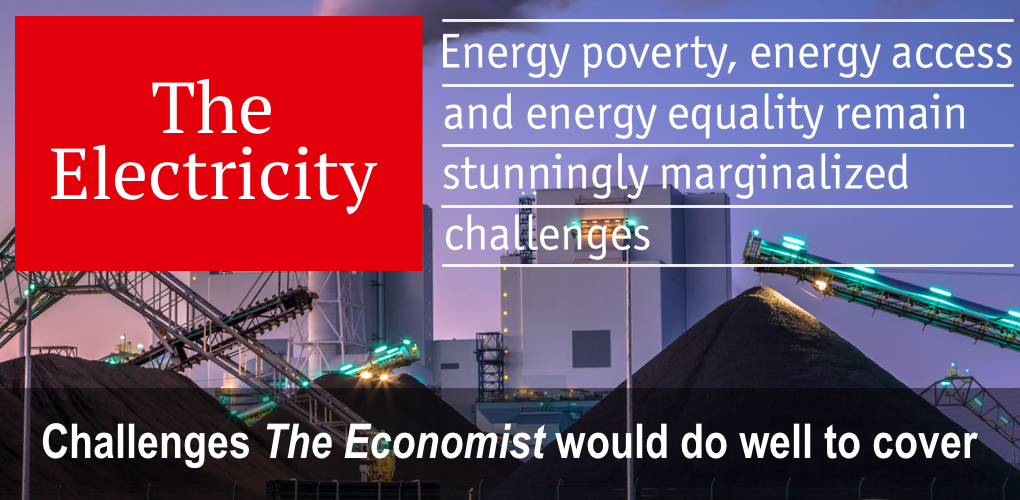
Energy poverty, energy access and energy equality remain stunningly marginalized challenges – challenges The Economist would do well to cover. Denying the world coal is a mistake. Denying the 3.5 billion people without reliable electricity access to coal is shameful. Failing to appreciate coal’s irreplaceable global role and the promise of technology solutions to ensure emissions reduction doesn’t throttle the ongoing fight to reduce energy poverty is simply bad journalism.
- On December 9, 2020