
The Transition to Crisis
The grid reliability crisis continues to deepen and spread. Warnings about capacity shortfalls and blackouts are so frequent and ubiquitous they are as regular as a utility bill.
Just this week, The Wall Street Journal found that, “from California to Texas to Indiana, electric-grid operators are warning that power-generating capacity is struggling to keep up with demand, a gap that could lead to rolling blackouts during heat waves or other peak periods as soon as this year.”
And it’s not just summer months and high heat stressing the grid. Fuel security and availability challenges are a problem from New England through the Mid Atlantic, Midwest and Texas. The failure of the Texas grid in February of 2021 came on the wings of a biting winter storm.
As The Journal has concluded, this crisis is driven by the loss of traditional sources of power and the pivot to renewable energy—a pivot that is proving uneven and poorly managed. Grid managers and utilities are now struggling with how to accelerate the deployment of renewable energy and battery storage while also keeping existing essential power plants online. It’s a problem without easy answers given that the deployment of renewable energy and its supporting infrastructure isn’t keeping up with conventional power plant retirements. It’s a challenge not just confined to the U.S.
“Every market around the world is trying to deal with the same issue,” Brad Jones, interim chief executive of the Electric Reliability Council of Texas, told The Journal. “We’re all trying to find ways to utilize as much of our renewable resources as possible…and at the same time make sure that we have enough dispatchable generation to manage reliability.”
As Jones alludes to, accelerating renewable deployment is hardly a cure-all for the capacity shortfall. Renewable capacity – while helpful at times – is dependent on the weather and time of day and can be severely reduced or a no-show when it’s needed most. Battery storage can help mitigate renewable power’s intermittency, but grid-scale batteries remain in their infancy and can provide hours of assistance, not the days or weeks of storage needed to deal with heatwaves, days-long storms or seasonal variability in wind and solar output.
“As we move forward, we need to know that when you put a solar panel or a wind turbine up, it’s not the same as a thermal resource,” said John Bear, Chief Executive Officer for the Midcontinent Independent System Operator, the grid operator for much of the Midwest.
His concern was echoed by the North American Electricity Reliability Corp., which warned in its long-term reliability outlook that, “capacity-based estimates, however, can give a false indication of resource adequacy. Energy risks emerge when variable energy resources… are not supported by flexible resources that include sufficient dispatchable, fuel-assured, and weatherized generation.”
Undermining PJM’s Capacity Market
Shockingly, no concerted effort is underway to address the problem. In fact, renewable advocates refuse to recognize this reality and are determined to make it far worse.
On the PJM grid, the nation’s largest, a new push is underway to undermine PJM’s capacity market, a system designed to ensure adequate dispatchable generation during periods of peak demand. Under the current system, renewable sources of power are only given partial credit for their capacity because of their intermittency. Now, some renewable advocates want that changed and they also want thermal resources, like coal and natural gas plants, to be given less credit. If these advocates get their way, the result will be even less dispatchable generation on the grid despite mounting concern over reliability.
Fortunately, not everyone is buying what these advocates are selling. While PJM has established a task force to evaluate potential changes to its capacity market, some leading stakeholders – such as the PJM Power Providers group, which actually owns generation in the PJM market – believe that intermittent resources are being given too much capacity value with PJM overestimating their ability to deliver power when needed. In other words, if any changes are needed to PJM’s capacity market, it’s to reinforce fuel-secure, dispatchable generation, not undermine it.
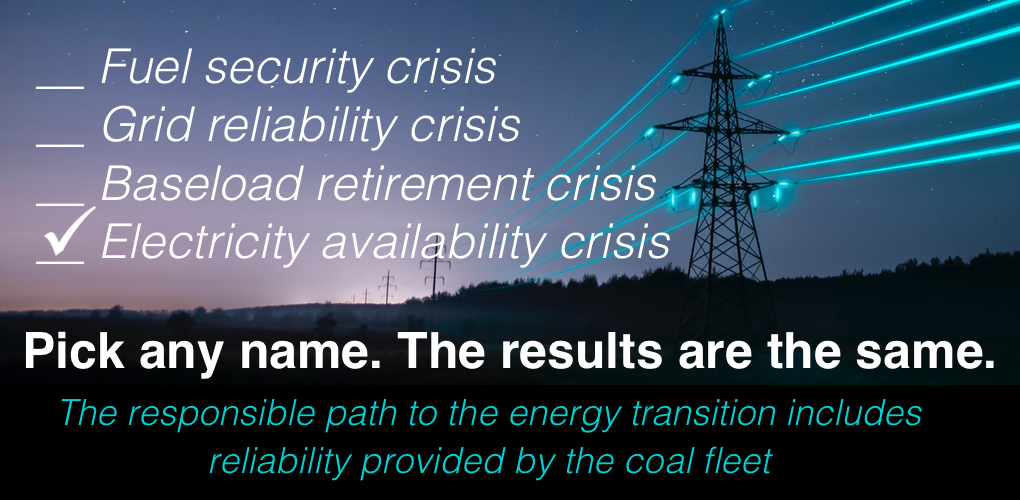
The loss of coal generation and the value it provides during peak summer and winter demand when natural gas can be hard to come by desperately needs reinforcing. The crisis unfolding before us has gone by several names: baseload retirement crisis, grid reliability crisis, fuel security crisis, and now electricity availability crisis. Regardless of the label, there’s a responsible path to the energy transition and we’re not on it. The coal fleet has a deeply important role in navigating the transition ahead. The sooner policy stops trying to dismantle this bulwark of reliability, the sooner we’ll be on the right track to defusing this crisis of our own making.
- On May 11, 2022