
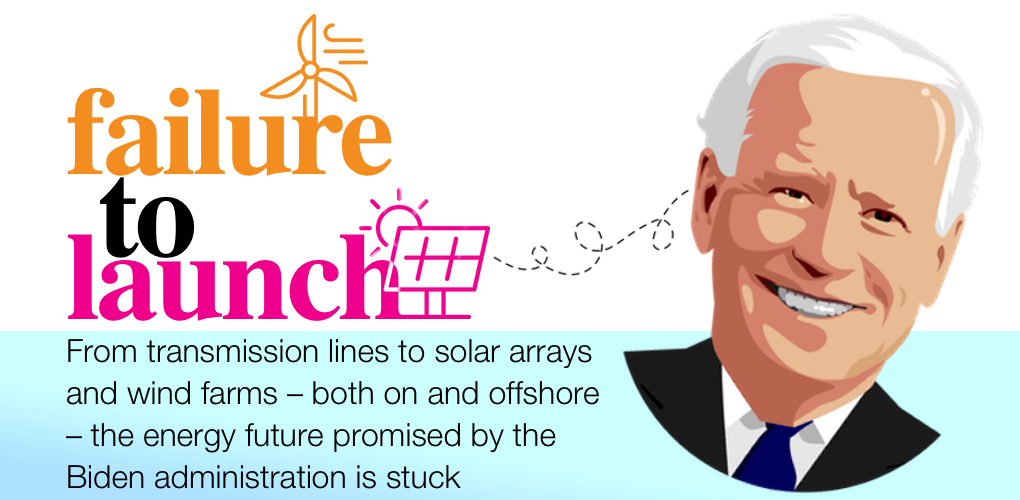
Failure to Launch
The SunZia transmission line has become emblematic of the challenges of delivering the nation’s energy future. The project – a $10 billion effort essential to moving wind generation across several states – had been stuck in legal limbo and permitting purgatory for 17 years until it was finally approved last year. But now several Tribes and the Center for Biological Diversity have sued the Department of the Interior over the approval, claiming parts of the permitting process weren’t thorough enough. In other words, after 17 years, not so fast.
From transmission lines to solar arrays and wind farms – both on and offshore – the energy future promised by the Biden administration is stuck in the 2006 Matthew McConaughey rom-com Failure to Launch.
This is the on-the-ground reality facing the Biden administration’s vision for the energy transition. Rising costs, delays, mounting community opposition and cancelled projects are everywhere.
According to a new survey from the Department of Energy’s Lawrence Berkley National Laboratory, roughly one-third of utility-scale wind and solar siting applications submitted over the last five years were canceled, while about half of wind and solar projects experienced delays of six months or more.
Interstate transmission additions are a fraction of what policy experts say are needed to enable a renewable-heavy energy mix. And the Biden administration’s flagship effort to jumpstart the nation’s nascent offshore wind industry and commission 30 GW of capacity by 2030 is – pun very much intended – facing some headwinds.
Despite extraordinary incentives to support the offshore industry, supply chain challenges, inflationary pressure and high interest rates are sending even seasoned offshore companies for the exit.
As the Wall Street Journal recently observed, “already, utilities have unloaded pieces of a planned New Jersey wind farm and a yet-to-be-built seabed off Massachusetts. Now, ‘for sale’ signs sit on stakes in four developments aimed at electrifying hundreds of thousands of homes in New York, Connecticut, Rhode Island and Virginia.”
A leading energy consultancy, ClearView Energy Partners, estimates that 30% of planned offshore wind capacity contracted through state procurements has been canceled with more cancellations likely.
Grid operators, utilities and the nation’s grid reliability regulators are watching with rising alarm a projected shortfall in needed generating capacity in the years ahead. Accelerating baseload power plant retirements – driven by a zealous regulatory agenda – are colliding with soaring electricity demand and an inability to meet it. Something must give.
The inability of the Biden administration to accept what is so painfully obvious to those tasked with keeping the lights on and homes warm is a ticking time bomb.
Racing ahead with closing essential capacity as the nation struggles to build new generation and enabling infrastructure is policy malpractice. Can the administration discover some energy pragmatism? Can it course correct and avoid a grid reliability disaster of its own making? As the Environmental Protection Agency’s regulatory agenda comes to a head in the next few months, we’re poised to find out.
- On January 30, 2024