
The Next Winter Grid Disaster
If the lights went out for millions of Americans on a frigid day would there be much surprise? There would be shock – and there would be plenty of finger pointing – but “surprise” is a word that might be tellingly missing.
In fact, some major regional grid operators might be more likely to be “surprised” when the power doesn’t go out during periods of peak winter demand. You can almost see the back-patting and high fives from operators when grids squeak by as bitter cold pushes systems to the very edge, as it has over the past few days.
For even the most seasoned veterans, there’s an increasing uneasiness that the grid simply may not have what it needs. The nation’s grid reliability regulator, in fact, warned that 180 million people could face power shortages this winter.
Grid operators across the country are left facing increasingly unsettling questions without good answers. Will wind and solar power be able to contribute? Will the natural gas system hold up or will power plants be left without fuel? Will consumers respond to conservation requests?
Everyone – from families watching the news to the operators in the control room – is crossing their fingers and hoping for the best. It’s an absurd situation, and it’s also the alarming reality for the nation’s increasingly unreliable supply of power.
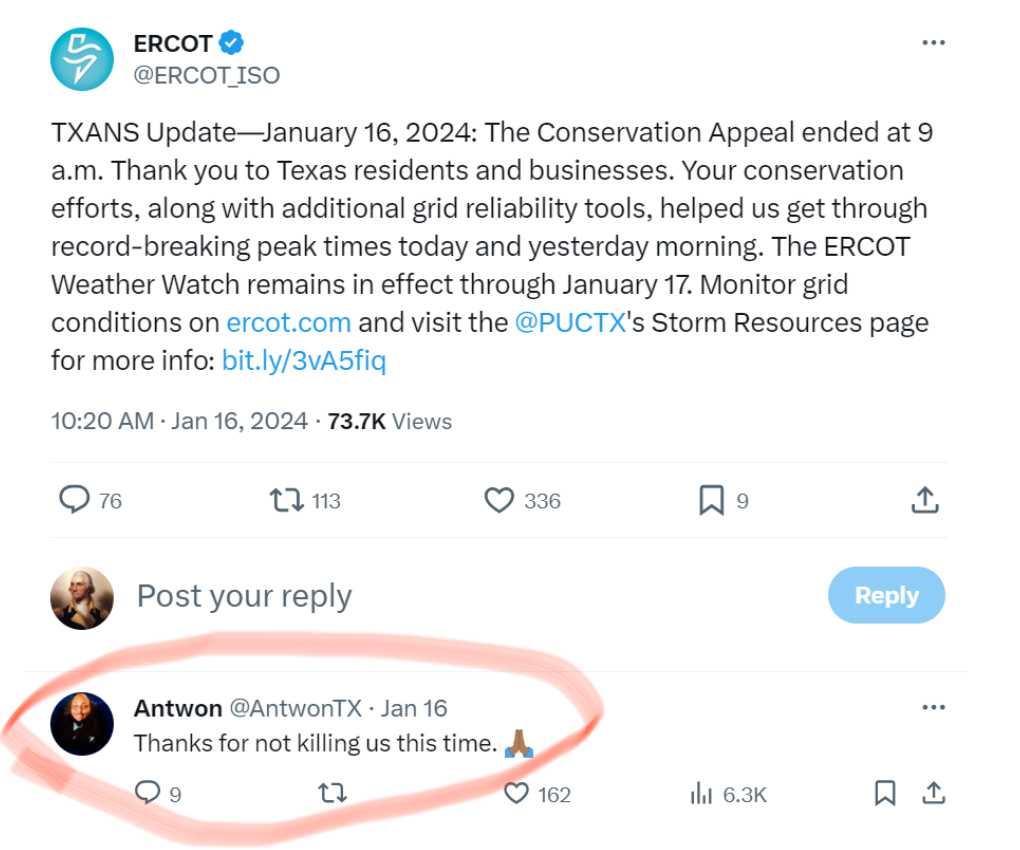
Consider this recent conservation appeal from ERCOT, the grid operator for most of the state of Texas, for January 15. ERCOT warned that operating reserves were expected to be low due “to continued freezing temperatures, record-breaking demand and unseasonably low wind.”
In other words, for a system that has invested billions in wind generation – no state has more wind capacity – on one of the coldest days of the year, that very capacity was expected to largely be a no-show, putting the system under immense stress.
People are increasingly frustrated and rightfully so. As ERCOT thanked consumers for their help in keeping the lights on this weekend, a Texas resident irreverently Tweeted back, “Thanks for not killing us this time.”
Recall that in February of 2021, during Winter Storm Uri, 4.5 million Texans lost power and 246 lost their lives in freezing temperatures. As catastrophic as that event was, it could have been far worse. And the deeply unsettling reality for Texans and tens-of-millions of other Americans, is that the dynamics that enabled that disaster have only gotten worse since, not better.
Electricity demand is surging across the country, the natural gas system remains extraordinarily vulnerable to freezing temperatures, renewable intermittency is proving more problematic than boosters want to admit, and – most notably – the U.S. Environmental Protection Agency’s regulatory onslaught is taking essential dispatchable capacity off the grid far faster than it can be reliably replaced. In short, operators are facing increasingly challenging circumstances with fewer of the critically important tools – notably fuel-secure coal plants – they need to keep the system online.
A disaster that makes Winter Storm Uri seem tame is increasingly a matter of “when,” not “if.” As capacity reserves shrink across the country, as the regulatory blitz pushes more essential capacity off the grid and demand continues to grow, we will inevitably see areas of the country that are woefully short of capacity. Recently PJM, the operator for the nation’s largest grid, serving 65 million Americans from Virginia up through Pennsylvania and over to Chicago, projected that peak winter demand in its service territory is projected to jump more than 30 GW in the next decade. We’re all left with a deeply alarming question: what in the world is going to be left to meet it?
- On January 17, 2024