
Surging Capacity Prices in PJM Set off New Alarms
For months now, PJM’s leadership has warned of rapidly approaching power shortages. If there was any suspicion of exaggeration, PJM’s most recent capacity auction has put those rumblings to bed.
Capacity payments to generators in PJM, a sort of insurance premium to assure plants are available when needed, just jumped a remarkable 800% as rising power demand threatens to clash with diminishing supplies. Notably all the coal capacity offered in the capacity auction cleared – nearly 24 gigawatts – sending an unmistakable signal that the very coal capacity the U.S. Environmental Protection Agency (EPA) has targeted for elimination remains essential.
As Politico’s Peter Behr reflected on the remarkable results of the auction, there is a clear bottom line: “coal and natural gas plants are closing too quickly” and renewable sources of power are coming online too slowly.
“The significantly higher prices in this auction confirm our concerns that the supply/demand balance is tightening,” PJM CEO Manu Asthana said in a statement.
PJM estimates that the higher capacity prices will add an estimated $14.7 billion to customer rate payments. Exelon, which owns six utilities in the PJM footprint serving 10.5 million customers, has warned double digit rate increases are coming for many of its customers.
Coming Home to Roost
While the surge in capacity prices is supposed to send a signal to bring more capacity into the market, doing so is going to be easier said than done. Renewable capacity – supposed to be a cure-all for the market’s challenges according to supporters – is not getting built.
PJM’s Vice President of Planning Paul McGlynn recently observed, “right now, PJM has cleared nearly 40,000 megawatts of generation projects through our interconnection process that are not moving to construction. Nothing from PJM is holding these projects back.” Financing challenges, siting and permitting, and supply chain challenges are derailing renewable capacity additions all over the country.
The mounting challenges to adding desperately needed new capacity are colliding with surging power demand and EPA’s regulatory agenda. And importantly, there’s also a distinct mismatch between the capacity renewables can add and what is being lost with the closure of existing coal plants.
Wind and solar capacity – subject to the vagaries of the weather – simply can’t be counted on to provide generation at nearly the level coal plants can. Replacing every lost megawatt of coal capacity takes many times over additions of wind and solar power, and that still may only provide replacement capacity in name only. Dozens of new solar installations may look like much-needed reinforcements on paper but are as helpful to meeting power demand on bitterly cold winter nights as palm trees.
Higher capacity prices and their downstream effect of higher rates for consumers simply may not alleviate the supply crunch in PJM as long as the market is upended by EPA’s regulatory mandate. EPA is forcing capacity to close the market is screaming it needs.
PJM’s Independent Market Monitor has warned the grid is likely to lose an alarming 58 gigawatts of capacity by 2030, almost all of it traditional dispatchable capacity. Replacing it – while also trying to meet soaring demand – appears to be an increasingly tall, if not impossible, order.
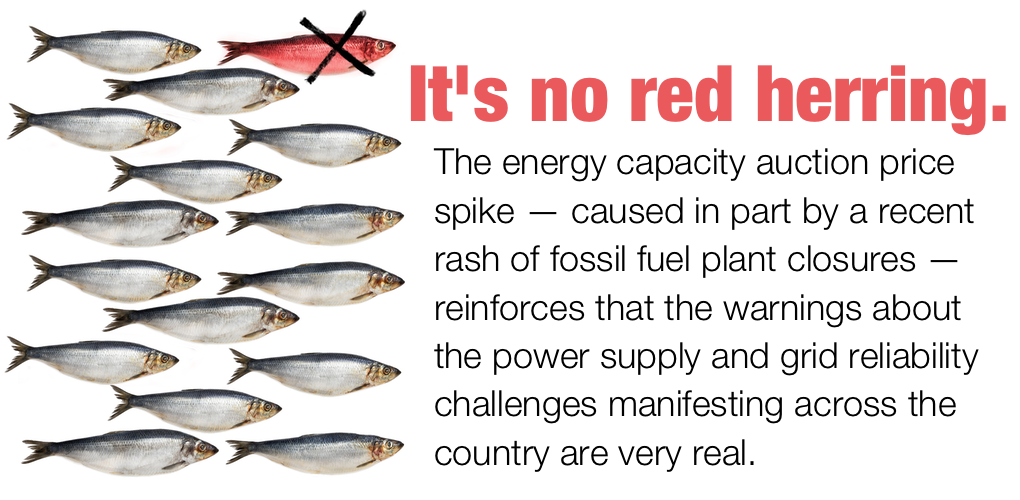
The PJM grid is in crisis. Surging capacity prices have confirmed it, and what’s happening in PJM is alarmingly indicative of the power supply and grid reliability challenges manifesting across the country. As one sharp analyst told Utility Dive, “one of the key take aways from the auction results is that the recent rash of fossil fuel plant closures is not the reliability red-herring as some people have claimed, since the reliability red-herring has come home to roost.”
- On August 14, 2024